- Online decision in minutes.
- Easier To Manage

Struggling with Debt?
Consolidate All Into One
From
Consolidate Your Debt
Consolidate-Credit is a lead generation firm only. We don’t give debt advice and can’t tell you which debt solution is right for you. We provide general information on debt options and, with your consent, pass your details to an FCA-authorised firm that can. Debt Solutions may not suitable in all circumstances, fees may apply, your credit rating may be affected

Consolidate Debt With Confidence
4.9/5 Rated ‘Excellent’

Money Helper is a free service set up by the Government to help people make the most of their money. Click here if you would like to learn more about Money Helper and their services.
How It works?
1. Complete your application
Taking the first step starts with a conversation. The friendly, understanding team are here to listen, understand your circumstances and help you explore your options without judgement.
2. Connect you with an authorised provider.
With your consent, pass your details to an FCA-authorised debt firms & licenced insolvency practitioners. We never pass them to anyone else without your consent.
3. Consolidate your debts
No two financial situations are the same. They will take the time to understand your circumstances, review your options and help you identify a practical solution tailored to your needs and consolidate your debts.
Consolidate-Credit is a lead generation firm only. We don’t give debt advice and can’t tell you which debt solution is right for you. We provide general information on debt options and, with your consent, pass your details to an FCA-authorised firm that can. Debt Solutions may not suitable in all circumstances, fees may apply, your credit rating may be affected
Money Helper is a free service set up by the Government to help people make the most of their money. Click here if you would like to learn more about Money Helper and their services.
Why Consider Debt Consolidation?
One Monthly Payment
Replace multiple eligible debt repayments with one monthly repayment.
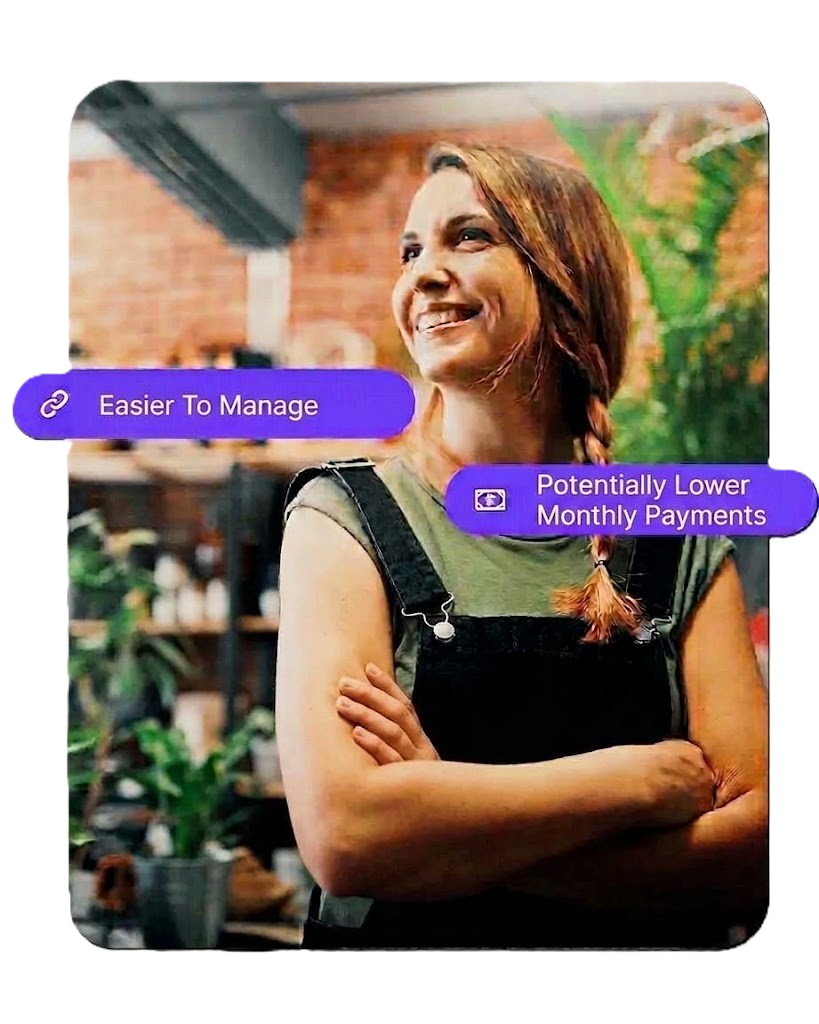
Easier To Manage
One payment date can make your monthly finances simpler to keep track of.
Potentially Lower Payments
A longer or more suitable repayment term could reduce your monthly outgoings, subject to the overall cost.
Debt Solutions may not suitable in all circumstances, fees may apply, your credit rating may be affected
Debt consolidation FAQs
What is a Debt Consolidation?
Debt consolidation is used to repay or consolidate existing debts. Instead of managing multiple debts separately, you may be able to replace some or all of them with one payment.
What Debts Can I Consolidate?
Credit cards
Bring eligible credit card balances together.
Personal loans
Explore whether existing personal borrowing could be consolidated.
Store cards
Potentially consolidate eligible store card balances.
Overdrafts
Explore options for dealing with eligible overdraft borrowing.
Will Applying Affect My Credit Score?
No impact on your credit score we use Soft credit checks that don’t affect your credit score. If you do take up a debt solution your credit rating may be effected.
What are the Consolidation options?
Consolidation options vary depending on your circumstances you will be provided all the pros & cons of each option.
Debt Solutions may not suitable in all circumstances, fees may apply, your credit rating may be affected
What are the Debt Solutions options?
Debt Management
A Debt Management Plan is an informal agreement with creditors to repay unsecured debts at an affordable rate. Payments are usually based on the individual’s disposable income, and creditors may agree to freeze or reduce interest and charges, although they are not required to do so.
Pros
Flexible payments based on affordability.
No formal insolvency proceedings or court approval required.
Can help avoid creditor enforcement action while repayments are maintained and creditors cooperate.
Cons
Creditors can refuse the plan, continue charging interest or take enforcement action.
Debts may take many years to repay.
Creditors can withdraw their cooperation, and the arrangement does not legally bind them.
Individual Voluntary Arrangements (IVAs)
An IVA is a formal, legally binding agreement between an individual and their creditors to repay an agreed amount over a set period, usually five or six years. It is supervised by a licensed insolvency practitioner and, once approved, binds creditors covered by the arrangement, subject to the statutory rules.
Pros
Can prevent creditors bound by the IVA from taking individual enforcement action in respect of included debts, subject to legal exceptions.
Allows individuals to retain assets, including their home, subject to the IVA terms and any equity provisions.
Remaining included unsecured debt may be written off upon successful completion, subject to the arrangement’s terms.
Cons
Requires approval by creditors under statutory voting rules.
Failure to comply with the terms can lead to failure or termination and potentially bankruptcy.
Fees apply, and the IVA can affect credit access and remain on the Individual Insolvency Register for the applicable period.
Bankruptcy
Bankruptcy is a formal insolvency procedure that can release an individual from most qualifying debts. A trustee may take control of assets to realise funds for creditors, and income payments may be required where the individual has sufficient surplus income.
Pros
Can provide a relatively quick route to discharge from most qualifying debts, usually after 12 months.
Stops most individual creditor recovery action, subject to statutory exceptions.
Offers a route to dealing with debts that are otherwise unaffordable or impossible to repay.
Cons
Assets, including property equity, may be sold to repay creditors.
Certain professions, business activities and company directorships may be restricted.
Bankruptcy can seriously affect creditworthiness and may involve income payments for up to three years.
Debt Relief Orders (DROs)
A DRO is a formal debt solution intended for individuals with relatively low levels of qualifying debt, limited assets and low surplus income. It is available to eligible individuals in England and Wales and generally lasts 12 months, during which qualifying creditors cannot pursue the included debts without permission. Qualifying debts are normally discharged at the end if the DRO is not revoked.
Pros
No upfront application fee under the current scheme.
Provides protection from most creditor action relating to included debts during the DRO period.
Qualifying debts are normally written off after 12 months if the DRO remains in force.
Cons
Strict eligibility criteria apply, including limits on qualifying debts, assets and surplus income.
Certain assets and debts are excluded, and eligibility can be affected by homeownership.
Can affect creditworthiness and restrict access to further credit during the DRO period.
Breathing Space
Breathing Space is a government scheme in England and Wales that gives eligible individuals temporary protection from creditor action while they seek debt advice and work towards a longer-term solution. Standard Breathing Space lasts up to 60 days, while the Mental Health Crisis Breathing Space lasts for the duration of qualifying mental health crisis treatment, plus 30 days.
Pros
Temporarily protects against most enforcement action, creditor contact about included debts and interest or charges on those debts.
Provides time to seek professional debt advice and assess suitable debt solutions.
Can help reduce immediate financial pressure without requiring an immediate commitment to an insolvency solution.
Cons
It does not write off debts or pause the requirement to make ongoing contractual payments.
Standard protection generally lasts only 60 days and is not a long-term solution.
Eligibility requirements apply, and creditors may still take certain permitted actions during the protection period.
Full and Final Settlement
A Full and Final Settlement is an agreement with a creditor to accept a lump-sum payment, usually less than the total outstanding balance, in settlement of the debt. The creditor must agree to the terms, and the agreement should clearly confirm that the payment satisfies the debt in full, with no remaining balance to pursue.
Pros
Can reduce the total amount needed to clear a debt.
Provides a relatively quick way to resolve an individual debt without entering a formal insolvency procedure.
Can reduce ongoing financial pressure by removing the settled debt from future repayment commitments.
Cons
Requires access to a lump sum, which may be difficult to obtain.
Creditors are not obliged to accept a reduced settlement offer.
The settlement may affect credit records, and the debt could remain partly outstanding if the creditor has not explicitly agreed to write off the balance.
Consolidate-Credit is a lead generation firm only. We don’t give debt advice and can’t tell you which debt solution is right for you. We provide general information on debt options and, with your consent, pass your details to an FCA-authorised firm that can. Debt Solutions may not suitable in all circumstances, fees may apply, your credit rating may be affected
Consolidate-Credit owned and operated by tion finance LLC, 1309 Coffeen Avenue STE 1200, Sheridan, Wyoming 82801, USA, connects you with services that provide debt information and referrals to FCA-authorised debt firms and licenced insolvency providers. We are not a lender and do not give credit, Not FCA-authorised We act as a Lead Generator only . Your data is handled in line with the UK GDPR and the Data Protection Act 2018. ZC278247 ©
Consolidate-Credit is a lead generation firm only. We don’t give debt advice and can’t tell you which debt solution is right for you. We provide general information on debt options and, with your consent, pass your details to an FCA-authorised debt firms & licenced insolvency practitioners that can.
Consolidate-Credit is an introducer, not a debt adviser. We are not authorised or regulated by the Financial Conduct Authority. We are not a charity or a government body.

To find out more about managing your money and getting free advice, visit Money Helper, an independent service set up to help people manage their money.